SingleFileBackend
-
class
bruty.world_raster_database.SingleFileBackend(epsg, x1, y1, x2, y2, history_class, storage_class, data_class, data_path)¶ Bases:
bruty.world_raster_database.WorldTilesBackend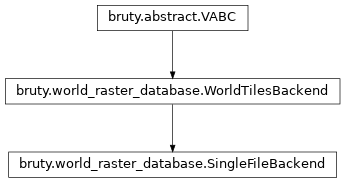
Attributes Summary
- rtype
int
Methods Summary
append_accumulation_db(accumulation_db)get_crs()get_tile_history(x, y)get_tile_history_by_index(tx, ty)get_tiles_index_matrix(x, y, x2, y2)Get the indices of tiles that fall within rectangle specified by x,y to x2,y2 as a pair of numpy arrays.
get_tiles_index_sparse(x, y, x2, y2)Get the indices of tiles that fall within rectangle specified by x,y to x2,y2 as a sparse list.
get_tiles_indices(x, y, x2, y2)Get the indices of tiles that fall within rectangle specified by x,y to x2,y2 as a numpy array of tuples.
iter_tiles(x, y, x2, y2)make_accumulation_db(data_path)Make a database that has the same layout and types, probably a temporary copy while computing tiles.
str_to_tile_index(strx, stry)Inverses the tile_index_to_str naming
tile_index_to_str(tx, ty)A function that can be overridden to change how directories are created.
Attributes Documentation
-
epsg¶ - Return type
int
-
id
Methods Documentation
-
append_accumulation_db(accumulation_db)
-
get_crs()
-
get_tile_history(x, y)
-
get_tile_history_by_index(tx, ty)
-
get_tiles_index_matrix(x, y, x2, y2)¶ Get the indices of tiles that fall within rectangle specified by x,y to x2,y2 as a pair of numpy arrays. Each entry of the returned array is the tx,ty index for a tile. Note that Tile indices are x -> tx which means it is essentially (column, row).
e.g. if the tiles being returned were from tx = 1,2 and ty = 3,4 then the returned value would be (array([[1, 2], [1, 2]]) , array([[3, 3], [4, 4]]))
- Parameters
x –
y –
x2 –
y2 –
- Returns
- Return type
Tile X and Tile Y numpy arrays of shape (n, m)
-
get_tiles_index_sparse(x, y, x2, y2)¶ Get the indices of tiles that fall within rectangle specified by x,y to x2,y2 as a sparse list. Each entry of the returned list is the tx or ty index for a tile. Note that Tile indices are x -> tx which means it is essentially (column, row).
e.g. if the tiles being returned were from tx = 1,2 and ty = 3,4 then the returned value would be [1,2], [3,4]
- Parameters
x –
y –
x2 –
y2 –
- Returns
- Return type
List for tile x of length n and list for tile y of length m
-
get_tiles_indices(x, y, x2, y2)¶ Get the indices of tiles that fall within rectangle specified by x,y to x2,y2 as a numpy array of tuples. Each entry of the returned array is the tx,ty index for a tile. Note that Tile indices are x -> tx which means it is essentially (column, row).
e.g. if the tiles being returned were from tx = 1,2 and ty = 3,4 then the returned value would be array([[1, 3], [2, 3], [1, 4], [2, 4]])
- Parameters
x –
y –
x2 –
y2 –
- Returns
- Return type
numpy array of shape (n,2)
-
iter_tiles(x, y, x2, y2)
-
iterate_filled_tiles()
-
make_accumulation_db(data_path)¶ Make a database that has the same layout and types, probably a temporary copy while computing tiles.
- Parameters
data_path – Place to store the data. A local temporary directory or subdirectory inside of this directory would make sense if deleted later
- Returns
- Return type
WorldTilesBackend instance
-
str_to_tile_index(strx, stry)¶ Inverses the tile_index_to_str naming
-
tile_index_to_str(tx, ty)¶ A function that can be overridden to change how directories are created. The default is just to return the index as a string. An overridden version could add north/south or special named (like 2359, 4999 in TMS_mercator is Atlantic_Marine_Center).
- Parameters
tx – tile index in x direction
ty – tile index in y direction
- Returns
- Return type
(str, str) of the x and y strings respectively.
-
__init__(epsg, x1, y1, x2, y2, history_class, storage_class, data_class, data_path)¶ - Parameters
tile_scheme – an instance of a TilingScheme derived class which defines what the coordinate to tile index will be
history_class – A History derived class that will store the data like a mini-repo based on the tile scheme supplied - probably a RasterHistory
storage_class – The data storage for the history_class to use. Probably a MemoryHistory or DiskHistory
data_class – Defines how to store the data, probably derived from raster_data.Storage, like TiffStorage or MemoryStorage or BagStorage
data_path – Root directory to store file structure under, if applicable.